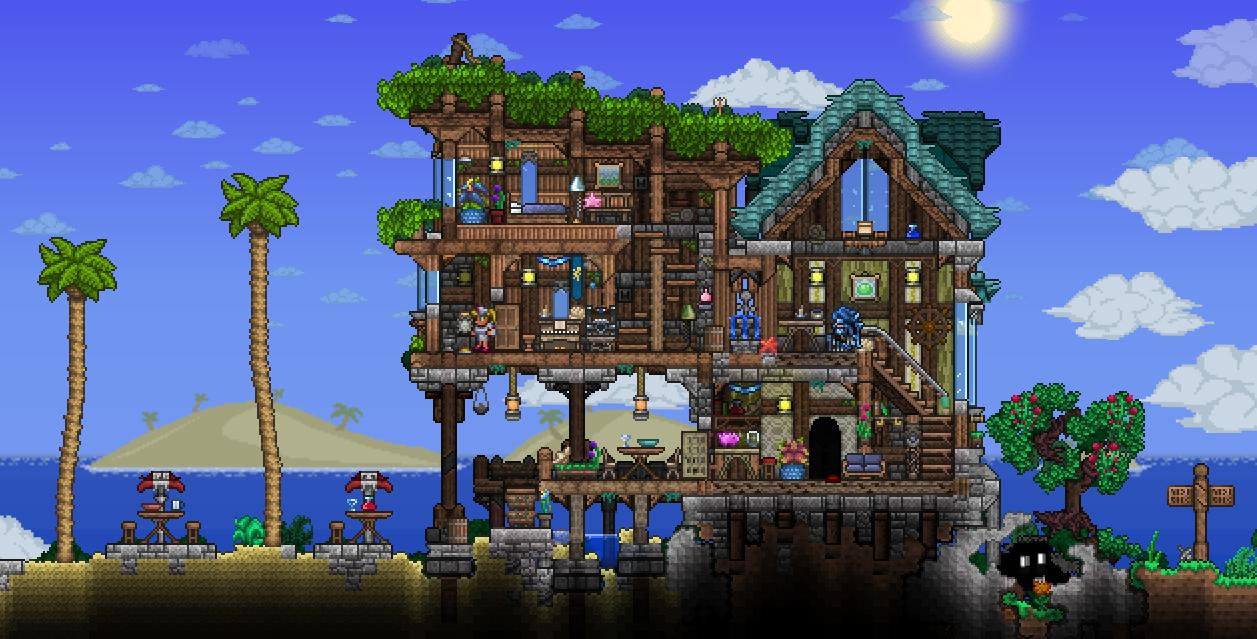
Terraria for PC. Image credit: fanart on official Terraria twitter account
Terraria (2011)
Last year I tried to plug some of the holes in my gaming experience — especially RPGs like Elder Scrolls, Mass Effect, Planescape Torment, and Persona — but several prominent gaps remain: World of Warcraft, MOBAs, Minecraft. Not playing this latter makes it hard for me to evaluate Terraria in its full context: Terraria’s elevator pitch is “2D Minecraft.” If you, like me, hadn’t played the cubed classic, here’s the gist: you are dropped into a grid-aligned forest with a simple pickaxe and dig, build, craft, dig more, build more, craft more, etc. At night, monsters come out and you may need to withdraw into your fortress and batten down the hatches. Over time you repeat a relatively simple yet satisfying loop where each round of new equipment allows you to go deeper and further to collect the resources to make yet better equipment.
As with Minecraft there is an almost overwhelming degree of freedom in Terraria. Many players spend their time building literal castles in the sky. I whiled away hours of domestic bliss constructing a vast underground library, a rooftop statue garden, a marble-lined indoor pool, and a network of minecart railways to reach the furthest corners of the kingdom. Kelley was more into exploration and combat, mapping out the many surface and subsurface biomes, gathering resources, and thinning out the hordes of undead with her trusty yo-yo. For us, a key feature of Terraria was progression (not to be mistaken for actual story) that provided direction when we felt goal-oriented. Working together to find rare artifacts, fight bosses, and break into harder areas was exhilarating, and I suspect I’ll struggle to find the same motivation in a more open-ended sandbox environment.
Terraria won’t win many points for originality, but it deserves credit for taking Minecraft’s formula in its own direction and supporting their community with a truly insane amount of free content for many years beyond the original release. Kelley and I each topped the 100 hour mark, sometimes playing late into the night, in what was easily our favorite explicitly co-op experience of 2019.
Score: 10 / 10
–Brian
Writing up this Terraria review is particularly timely, given that I started playing Minecraft just last month. The games have a lot of similarities – you have blocks, you build with them, you explore, you craft, and you stave off mobs of bad guys. However, the sheer delight that I got from Terraria is far, far greater than any I have experienced in Minecraft.
Terraria is bright, colorful, dynamic, and chock-full of interesting things to uncover. Underground mushroom land? Yes. Evil unicorns? Sure. The ability to mine cloud blocks? Absolutely. The creators clearly had fun coming up with whimsical ideas and incorporating them into the game that made each discovery enjoyable. I truly loved setting out on an adventure, coming across something I had never seen, and hearing the slight tinge of jealousy in Brian’s voice as I announced my discovery. (The jealousy thing went both ways.)
The one mark against Terraria was the lack of direction with crafting. There are literally hundreds of items that you can create, but no in-game guidance explaining how, why, or if you should even bother. We spent hours on the wiki trying to figure out if, for example, cactus armor was better than tin armor and then what was needed (materials and equipment) to make it. Every time we had to pull out our phones to look at the wiki snapped us out of the otherwise blissful trance.
I loved Terraria and do not regret a single one of the 100+ hours.
Score: 10 / 10
–Kelley
Dust: An Elysian Tail (2012)
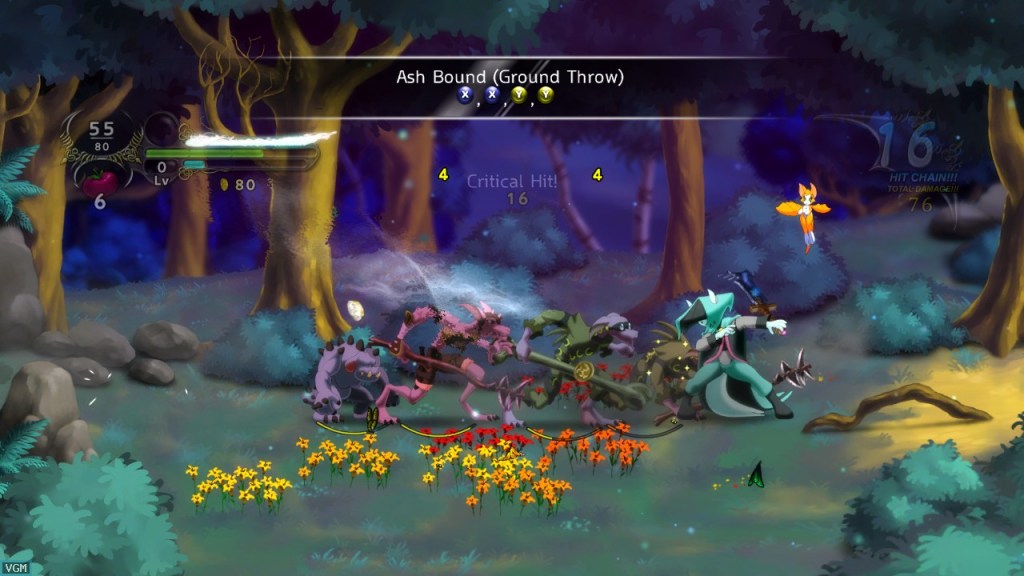
Too many games start with a conveniently amnesiac protagonist. Sometimes, this ends up working and the story goes in interesting and unexpected ways. Sometimes it falls completely flat and nothing feels novel or new. Dust: An Elysian Tail lies somewhere in the middle: there were times the amnesia was groan-worthy, but it also allowed for some plot-driven moments that worked pretty well.
In Dust, you play a character searching to understand who he is and why he came to be in a forest outside of a small town. A sentient sword (and it’s guardian, Fidget) join with you as you begin to realize the world you have found yourself in. Beasts are ravaging the land and the Moonbloods, a race with strong magical powers, are dying off and fighting back. Over the course of the game, you learn a lot about the Moonbloods and General Gaius, the ruler of the land, as you run around on fetch-quests, fight beasts with your sword, and perform some solid platforming. I’m going to stop there to avoid any spoilers.
Dust wasn’t a particularly difficult game, but it was very engaging. The art style was appealing, with a lot of charmingly-drawn anthropomorphized characters. The story was surprisingly deep in places and had some turns I did not expect. In all, I enjoyed Dust quite a bit and would play another title set in this world.
Score: 8 / 10
–Kelley
Hexcells Infinite (2014)
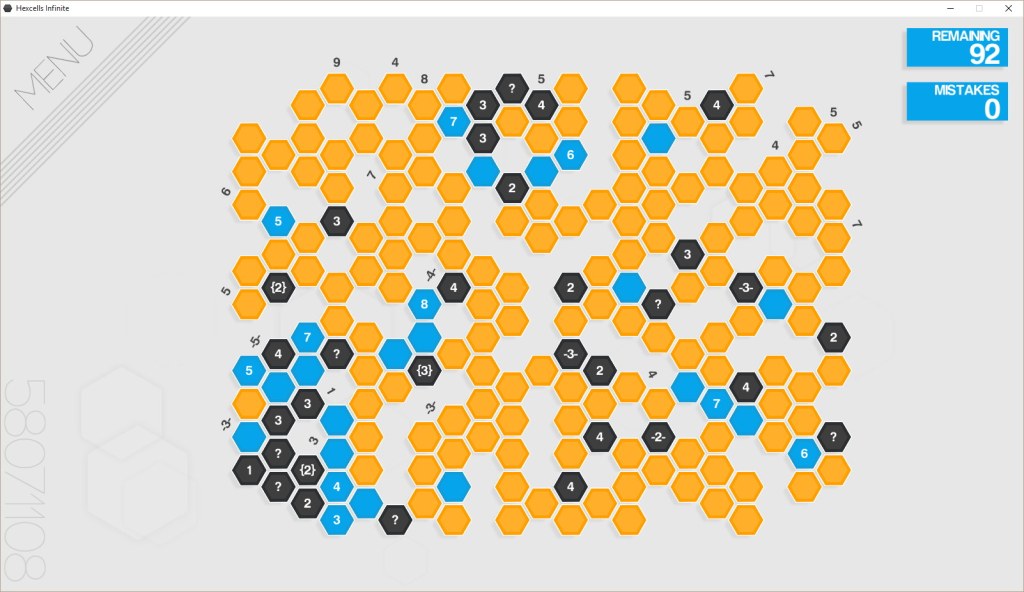
This is minesweeper on hexagons. You now have everything you need to determine if you are in or out on Hexcells, or really any Matthew Brown puzzle game. The 36 pre-built custom levels gradually introduce the rules and nomenclature, and the rest is up to your pure, unadulterated logical reasoning. Skills honed on Picross or Sudoku will carry you far, but expect to switch between mental algorithms more often.
For those who groove this vibe, Infinite Mode procedurally generates new puzzles so you’ll never be bored on public transport again. For my taste, however, there just isn’t enough variety or progression to keep coming back. This is the type puzzle game that is perfect for passing the time without shutting off your brain; but I’m not looking to merely pass my time.
Score: 4.5 / 10
–Brian
For more in this series see 2019 Trios.
 Significant Gamers