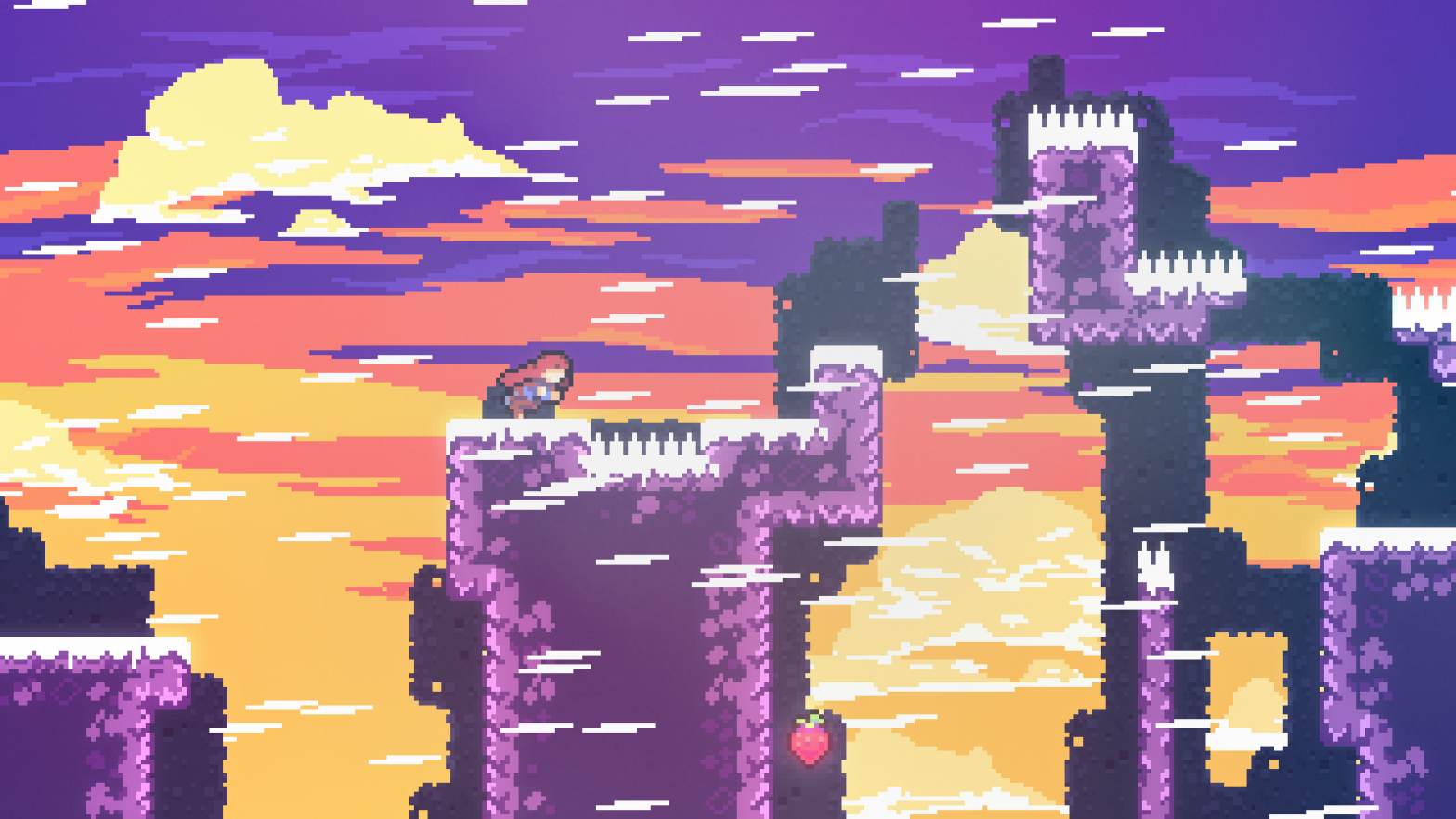
Celeste for the Nintendo Switch; Image Credit: Matt Makes Games
Today Kelley and I both tackle Celeste and finally play well-established series we’ve never previously attempted.
Celeste (2018)
From a distance, Celeste appears to be composed of simple, familiar elements. Heroine Madeline joins Zelda’s Link and Carmen Sandiego‘s gumshoe in the dubious pantheon of protagonists who will be inevitably confused with the title of their debut appearance. You’ll double-jump over spikes and pits to reach the highest point in each area. The highest point of all is the titular mountain Celeste, an actual peak in British Columbia.
What makes Celeste special is the polish every element exhibits. The controls are incredibly tight. Your second jump is both a constraint (cardinal directions, consistent-distance) and a very flexible tool. The level design is demanding, but rarely cruel. Your ability to grab onto walls and even climb short distances adds just the right pause to catch your breath and forgive a near miss. When you die, you restart instantly and without any penalty other than resetting the current screen. The progression introduces new mechanics just as you’ve mastered the previous. The collectable strawberries, unlockable “B-sides,” and hidden crystal hearts allow the player to customize the difficulty on the fly just by skipping anything that feels too frustrating.
But for me, what elevates Celeste over its nearest ancestor, Super Meat Boy, is that the heroine and her struggle are relatable and meaningful. That’s actually very rare in this genre. Consider the arbitrariness of characters like Mario or Sonic, and our corresponding lack of emotional investment in their journeys. Their antagonists are cartoon dinosaurs and mad scientists. Madeline figuratively and literally faces a mountain and the part of herself that tells her she can’t climb it. One of the many beautiful lessons of Celeste is that, unlike boss battles, mental health issues are rarely “beaten.” Instead we grow stronger by learning to recognize and live with them.
Score: 9.5 / 10
–Brian
Brian summed up a lot of what I loved about Celeste – the art style, mechanics, and treatment of mental health issues. What I think I liked most was the flow of the game. It starts deceptively simple, but quickly the player learns that they need to improve and possibly change how they play in order to get to the next screen and the one after that.
There’s a delicate line between a game that is constantly challenging the player to keep working, trying, and adapting and one that makes them want to rage quit with a tantrum of epic proportions. Celeste walks it perfectly. I distinctly remember white-knuckling my controller for hours trying to time my jumps and dashes properly to get to a platform or strawberry, but I never got too overwhelmed. Even the constant recording of my many, many deaths didn’t feel judgemental, just matter-of-fact.
Celeste was one of my most highly-anticipated games on the Switch and it did not disappoint.
Score: 9 / 10
–Kelley
Civilization VI
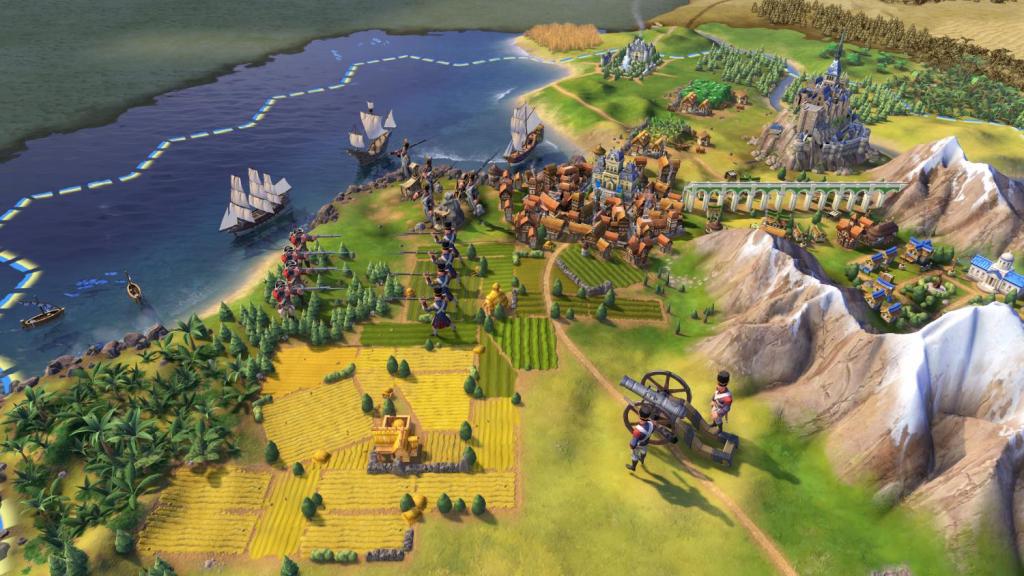
One of the major gaps in my computer game credentials was the Civilization series. Civilization, in all of its various forms and incarnations, always intrigued me, but never enough to sit down and dedicate the time required 1) to play and 2) to play decently. Despite my general awful-ness as turn-based strategy games, I decided to try it out.
The first thing you realize about playing a well-established franchise like Civilization is that there is a heck of a lot going on and the learning curve is steep. They have a dedicated following and history, and assume you know at least the basics of what you’re getting into. That said, Civ VI did have a nice tutorial/learning mode and the inclusion of an overwhelmingly-detailed encyclopedia of game actions and background answered many of my questions.
So far, I have only played one complete scenario of Civ VI. I lost. I lost rather horribly. I tried a strategy where I (Cleopatra) tried to be nice to everyone so I wouldn’t have to spend dwindling resources on a military presence. This failed. I forgot something rather crucial with this – you have to have money, resources, or a small enough footprint in order to be neutral. While I occasionally was able to entice a notable artist, author, military mind, scholar, etc. to visit my land, it was not enough to gain the prestige I needed to attempt a conflict-free victory.
In talking with others who had played Civ games in the past, I apparently didn’t understand that the point of the game is to squash everyone else into submission with technology.
Civ VI is quite challenging. The AI is beefed up for this installment because hardcore players complained about the game being too easy. Well. Thanks, guys.
I going to give it a healthy break, but I expect I’ll play another few games of Civ VI. I feel a bit less like a duck out of water now, so maybe I’ll have the edge I need to not come in dead-last against a bunch of robots.
Score: 8 / 10
–Kelley
Pokemon Red & Blue (1996)
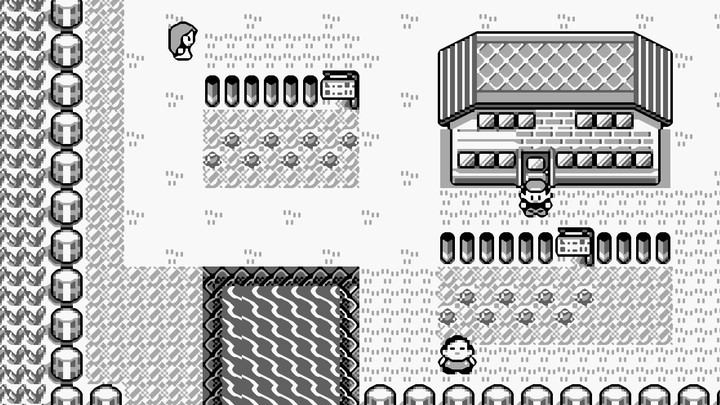
Growing up I just missed the Pokemon craze. I was starting high school and Pokemon Red/Blue seemed like stupid kid’s stuff. For decades after, I secretly regretted not getting in on the ground floor of what became a multi-media empire. A series of hikes with Pokemon Go aficionados kept the franchise on my radar. In 2019 I started working through a list of the most well-regarded games and my Waterloo finally arrived. I spiritedly booted up the ol’ emulator to give this foundational work a go.
Almost immediately I could see the underlying appeal of collecting outlandish critters to duke it out in an intricate spreadsheet of rock-paper-scissors relations. But just as quickly, the game’s flaws undermined the potential for strategy, world-building, exploration, and anything resembling fun. The writing is terrible. I literally cringed almost every time I sat down to force myself onward. The characters are generic and one-dimensional. The graphics were unimaginative and the type of level design that might have redeemed them was MIA.
Worst of all was the gameplay: a tedious, grind-fest full of repetitious random battles, redundant abilities, and opaque stats, which required either hours of trial-and-error or ready access to the internet (or perhaps, circa 1998, a sold-separately guidebook). I finally walked away after a “puzzle” where you mindlessly look into a grid of garbage cans hoping to find two completely randomized switches that allow you to progress. It was the perfect metaphor for my experience of the game as a whole.
Score: 1.5 / 10
–Brian
For more in this series see 2019 Trios.
 Significant Gamers