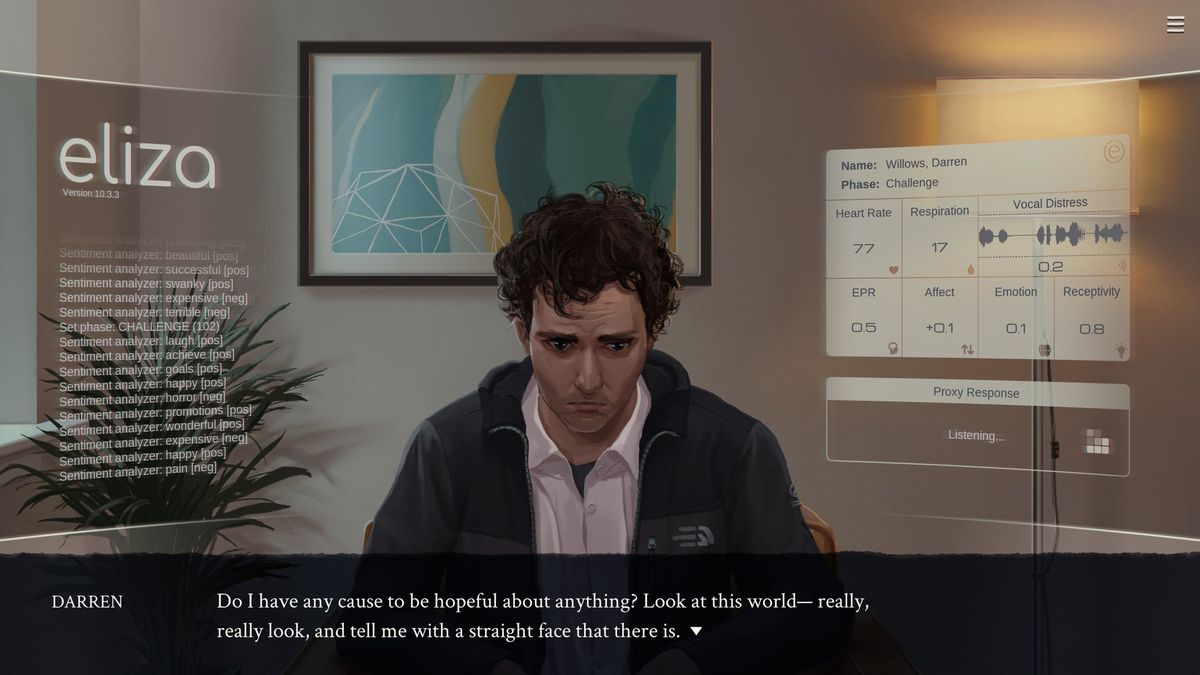
Eliza for PC; Image Credit: Zachtronics
Eliza (2019)
In the early 1990s my father brought home a computer with a chatty AI that demoed the sound card. It was called Dr. Sbaitso and it impersonated a psychologist by parroting what you typed or fixating on keywords and asking for details. My siblings and I spent hour trolling Sbaitso with absurd confessions. We eventually lost interest as we learned its rather modest limits, but I still think about that early excitement talking to a machine and wondering whether it understood my feelings. Fast forward to 2019, where the field of AI-assisted healthcare is booming, and the visual novel Eliza has some serious qualms.
You play as Evelyn, a burnt-out Seattle programmer and former core member of the team that designed Eliza, a therapist AI now in the stable of a powerful wellness app company. Without revealing your past connection, you are hired as a proxy, a human surrogate who reads Eliza’s prompts to give the machine a “human touch.” It’s a role both fascinatingly voyeuristic and weirdly dehumanizing. Over the course of several weeks you spend a lot of time listening to clients interact with Eliza and discussing the broader implications, next steps, and your own personal journey. You’ll converse with an ex-coder LGBT musician friend, a young idealistic chief engineer, a mental health colleague with a personal stake, a visionary but narcissistic tech CEO, and a visionary but smarmy psychologist. You hear their opinions and form your own.
I found the writing relatable and emotionally resonant and the subject matter brilliantly topical and multifaceted: our relationship with technology, controversial mental health trends, data privacy issues, startup culture, the difficulty of connecting with others, tough career choices, working with colleagues who are #MeToo scandals waiting to happen, and balancing self-care, ambition, and principles. Although released by Zachtronics, best known for their hardcore puzzle games, this is a pure visual novel, with no player inputs except for selecting dialog choices. Some of your interactions may feel a little bare-bones, but as the story progresses the options become weightier and steer the conclusion. I tried to make every decision as true to myself as possible, and literally paced my room mulling over real world relevant questions I hadn’t thought so hard about before. So perhaps Eliza, under the cover of gaming, accomplished what Dr. Sbatiso never could.
Score: 9 / 10
–Brian
Soma (2015)
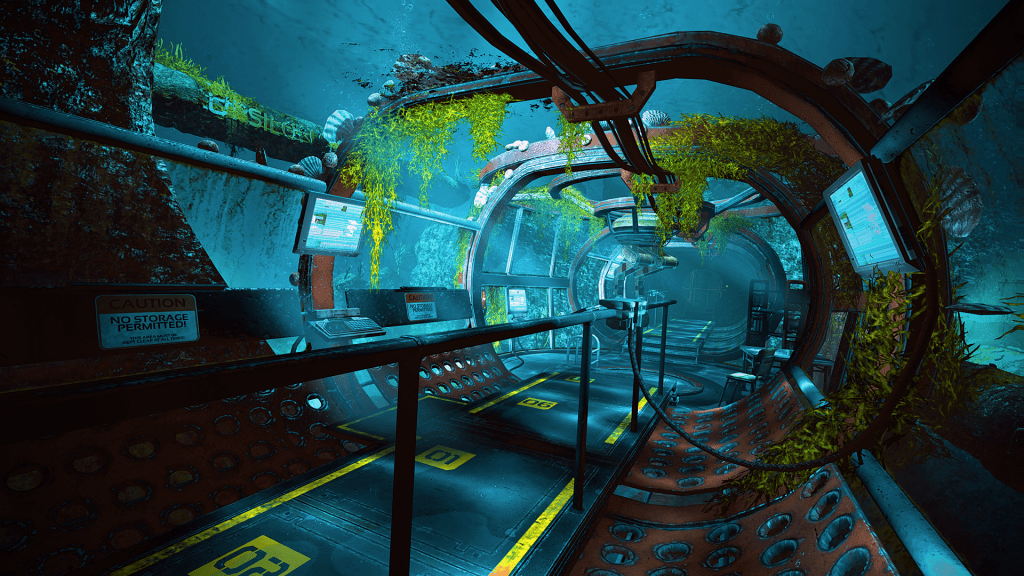
Many a survival horror game exploits our natural fears of darkness and dying, not to mention fleeing through cramped spaces from mutant-ghost-things, but few do it quite so underwaterly as Soma. In a prologue, you agree to have your brain scanned in the aftermath of a car accident. Next thing you know you wake up in an abandoned laboratory. Flickering lights. Broken glass. Bloodstains smeared down corridors. Yup, something went horribly wrong.
In the course of figuring out what happened, how you got here, and how to survive (all excellent mysteries), you’ll be hustled through a bunch of bathymetric bases that serve to space out existential revelations. What gradually unfolds is a science fiction tale of disaster, desperation, and transhumanism. However, I strongly suggest playing this on “safe mode” which retains most of the scary while excising the clumsy and unfun stealth segments. (The score below reflects my unfortunately decision to ignore this advice.)
The relatively smooth pacing and emphasis on plot and mood made Soma an excellent choice for playing in a group setting, my preference for survival horror. Just hand off the controller when you get too frightened!
Score: 6 / 10
–Brian
Soma looked scary. I don’t do scary.
-Kelley
Moonlighter (2018)
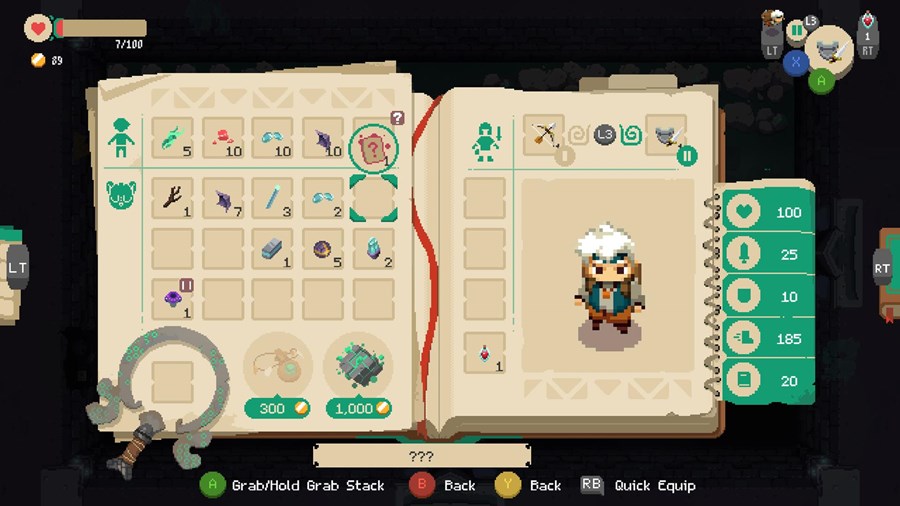
In Moonlighter, you play a young shopkeeper who yearns for adventure and goes dungeon-diving in order to stock up on inventory. As such, there are two main parts to the game: managing your shop during the day and exploring dungeons at night. In the day phase, you put items on shelves, price-adjust them based on customer reactions, stop shoplifters, ring up purchases, and, later in the game, take orders for specific goods. This is the way your character gets money to upgrade your shop and buy specialty wares.
The second part is the dungeon exploration. There are four themed, progressively-more-difficult dungeons in Moonlighter: golem, forest, desert, and technology. The player starts in golem and unlocks the others as they defeat the boss of the previous dungeon. Naturally, harder dungeons = rarer and more expensive items to sell and craft with. Each procedurally-generated dungeon is three floors and chock-full of bad guys. Kill all of the monsters in the room, get a chest of loot. Each floor has a fountain of healing – especially useful as you cannot save in a dungeon and getting KO-ed loses both in-game time and the contents of your backpack.
The best part of Moonlighter was their inventory system. Everyone who has ever played an RPG has cursed the limited number of slots in their trusty backpack. Moonlighter takes that concept and makes it into a punishing puzzle. You have three rows of five inventory slots. Want to pick up the Desert Steel Ingot? It has to go at either the top or bottom of your backpack. That Triple Cell Battery – it must go all the way to the left or right of your bag. Where it really started getting interesting were the items that were cursed, destroying the inventory object in the direction indicated by an arrow, or blessed, sending an object in a particular direction back to the safety of your shop. The pain of debating whether or not it was better to pick up one valuable object at the cost of another because of the inventory system was real. I had never seen anything quite like it in a game and thought it was brilliant, though frustrating.
To me, the dungeons and shop-management of Moonlighter did not live up to expectations. It seemed like my perfect combination: exploration and management simulation in one! I found the dungeons too much of a grind and the shop portion, though initially enjoyable, became a boring necessity.
Score: 5 / 10
-Kelley
For more in this series see 2019 Trios.
 Significant Gamers