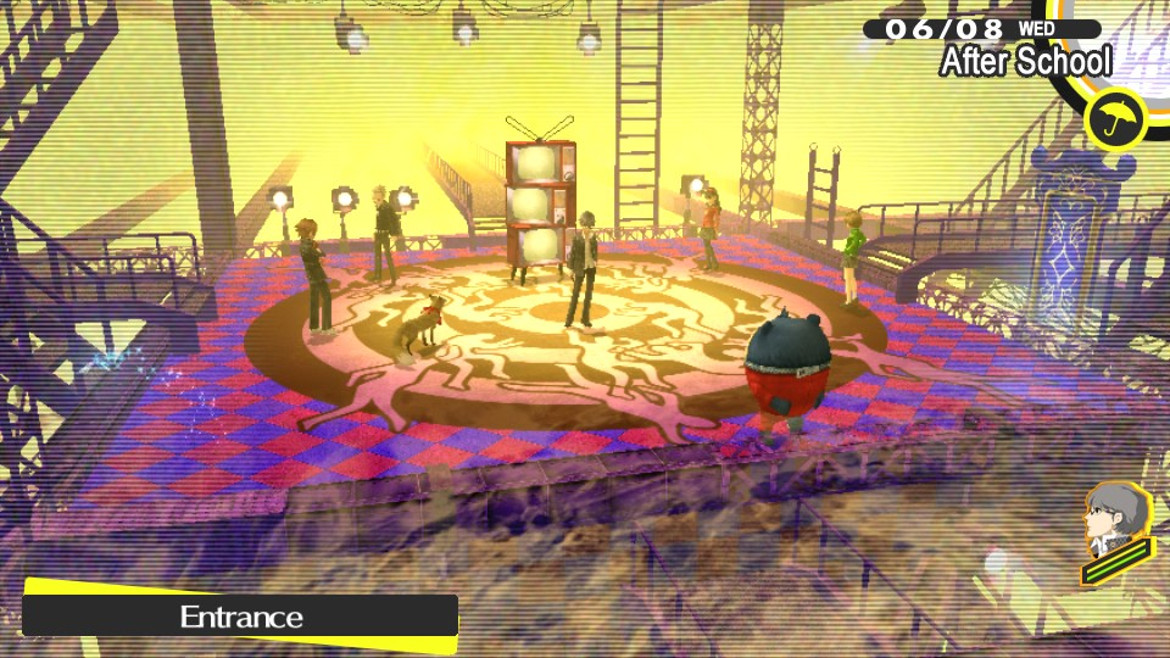
Persona 4 for PS2. Image credit IGN.com
Persona 4 (2008)
Implicit in almost every RPG, and most video games in general, is the idea that growing as a person is largely about increasing strength and improving skills. Persona tries a bold alternative that I absolutely love: you “level up” by dedicating time and attention to your social links: family, friends, colleagues, and community. You’ll still attack/guard/skill/item foes in turn-based combat, but you’ll divide your time between dungeons themed around suppressed fears and a life-sim based around a rural high school.
Shortly after city-kid Yu Narukami moves in with his uncle, Det. Dojima, and younger cousin, Nanako, strange deaths beset the formerly quiet village of Inaba. Together with an expanding team of classmates, you connect the murders to a “Midnight Channel” urban legend and a parallel “TV World” accessible to a select few. Each TV World dungeon is the private nightmare of an Inaba citizen on the verge of succumbing to their negative emotions and deep-seated insecurities, and rescuing the victim is as much about resolving these internal conflicts as it is about surviving a gauntlet of battles. (Though don’t underestimate the battles; Persona 4 is quite difficult and rather miserly with savepoints.)
The TV World only claims the life of its current prisoner on foggy days after heavy rain, so the weather forecasts can help estimate how long remains to gather clues about who has gone missing and why. In the meantime you’ll build relationships with the people in your life. These social links are central to the game, but have a steep learning curve of their own, not least because it takes good judgement, careful perception, and real maturity to help others deal with problems unique to their life stages, personal histories, and personalities. You’ll also need a crash course in Jungian psychology and occult mysticism along the way. Each bond is represented by a tarot card, which in turn improves the strength of certain persona — figures from world religion, folklore, and mythology — that affect your abilities in the TV World.
Persona 4 has a lot going on. The central mystery is compelling and creative. There are almost too many twists, culminating in not just a secret ending, not just a secret secret ending, but a secret x3 ending. (These are crucial to getting the full story, but are very hard to achieve on a first playthrough, so save often and don’t hesitate to consult a guide.) The cast of characters are among the most well-rounded and relatable in any game with interactions that are down to earth, but complex and weighty. I found the realistic setting, in particular, to be a nice break from high fantasy and space opera backdrops. And although the combat gets too grindy for my taste (this is an early 2000s JRPG), there is much strategic depth in the persona system. Of the 60-odd RPGs I’ve played, this is probably my favorite.
Score: 10 / 10
–Brian
A Good Snowman Is Hard to Build (2015)
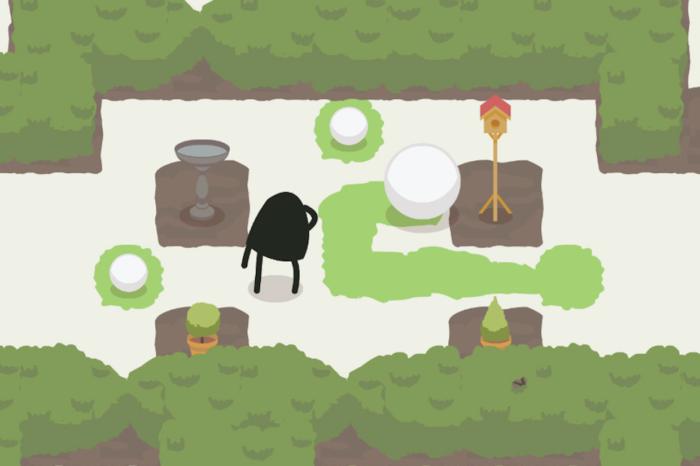
A seasonal sokoban-style puzzle game with a Flannery O’Connor pun in the title! Add to cart. This is a calm, almost zen game where you roll and stack snowballs in tiny hedge-bound gardens. The puzzles are never quite trivial, nor too hard, making this ideal as a guilt-free mobile diversion. For the real challenge make sure to stick around after finishing for the secret bonus content.
The graphics and music lean towards simplicity, but there are lots of pleasant details: you can see the path where you’ve rolled snow, the snowpeople all get names (and unique hats) and you can hug them, butterflies emerge if you solve a puzzle without leaving the area, you can rest on benches, etc. Skip your next coffee/soda and buy this game instead.
Score: 7 / 10
–Brian
Hidden Folks (2017)
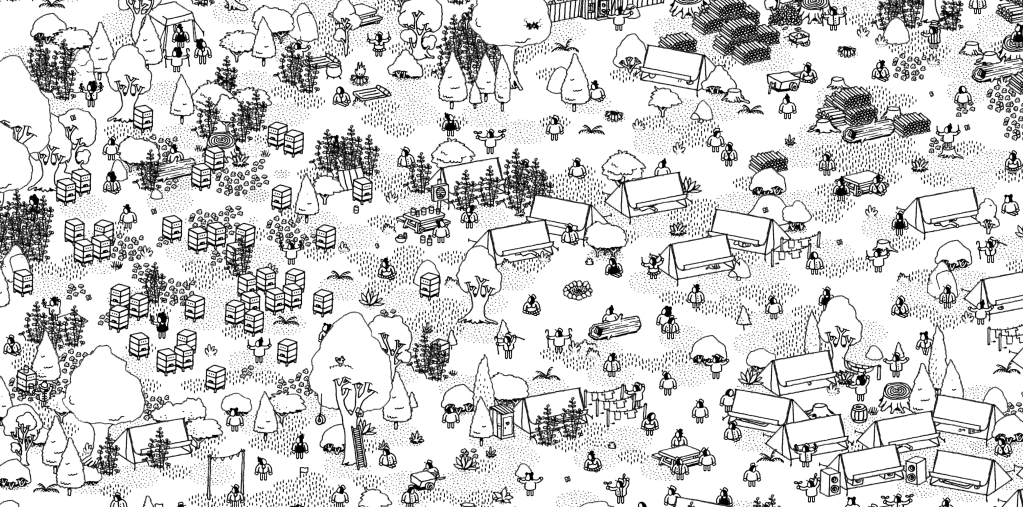
I grew up loving wimmelbilderbuchs. I didn’t know the fancy German word then, but I knew I loved hidden picture books. Many of my childhood favorites fall into this genre: Where’s Waldo, I Spy, and everything by Graeme Base. Basically you get a series of elaborate illustrations full of tiny details that can be poured over for hours while you hunt for particular objects. Hidden Folks is a straight-forward video game version of the concept, featuring hand-drawn landscapes teeming with adorable black and white figures and tiny animations (or at least a silly sound) wherever you click.
Find enough of the requested miniature trinkets or distinctive folks in one environment and you can progress to the next. Hidden Folks does what it does pretty well, but the lack of story, depth, or variation, eventually caused Kelley and I to move on to other games. Maybe, too, there’s something tactile about doing these in a book that can’t quite be captured on a screen.
Score: 4 / 10
–Brian
In Hidden Folks, the illustrations were great, the amount of detail put into the backgrounds was fantastic, the little animations added to the experience, and generally it was quite pleasant. Oddly enough, my biggest problem with the game was that it was too large. Each scene that you are searching is simply huge and the things that you are looking for are so very small. While there are some zoom capabilities, we found it best to be merely feet away from the television screen we were playing on – something that I do not care for. The game was cute, but we only made it through a fraction of the available play areas before giving up.
Researching the game again for the purposes of writing this review, I see that it is available on mobile devices. I think that is the ideal way to play Hidden Folks. You have more control over the zoom and camera, can move at your own pace, and can easily put it away when it becomes overwhelming.
Score: 6 / 10
–Kelley
For more in this series see 2019 Trios.
 Significant Gamers