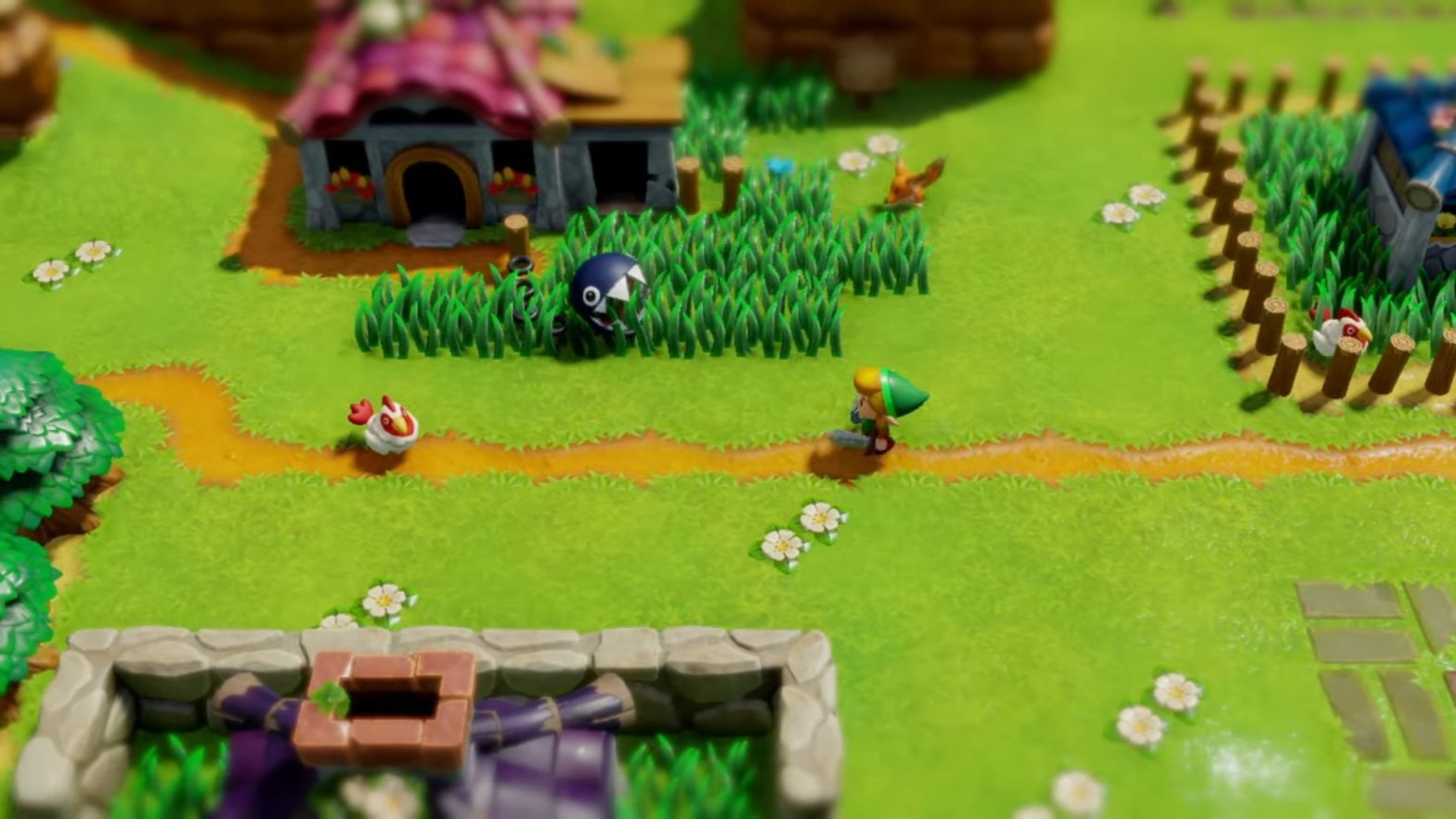
Link’s Awakening for Nintendo Switch; Image Credit: Nintendo
Today there is a stealth theme for the three reviews that will be revealed at the end. See if you can spot it before then!
Link’s Awakening (2019)
I played two Zelda games in 2019. Breath of the Wild was first – a sprawling open-world exploration adventure where I could lose myself for hours at a time (review to come in a later post). Shortly after my success (and Ganondorf’s defeat), Nintendo announced the Switch re-release of Link’s Awakening with updated graphics. I knew I would buy and play this game.
Link’s Awakening is very different from BotW. Now, this is likely obvious to anyone who had ever played more than one Zelda game, but I was going in with just the one point of reference. Whereas BotW is massive and you can do pretty much whatever you want in whichever order strikes your fancy, Link’s Awakening has you on a linear path. Both styles have their place and purpose and made for good games, but I was struck by how differently two titles from the same series played.
In Link’s Awakening, you control a newly-washed ashore Link who is trapped on an island. Naturally, he has lost his memories. As he works to figure out who he is and how to get off the island, Link fights some monsters and solves a series of dungeons. Though the original game came out in 1993 for the Game Boy Color, I don’t want to give anything away that could be “spoiler-y.”
Link’s Awakening is a nice game. The updated graphics and the re-release on the Switch make it accessible to a new generation of Nintendo gamers. While I greatly preferred the freedom and scope of BotW (again, watch this space for a future post!), I hope that Nintendo continues to update and release classic titles like Link’s Awakening.
Score: 7 / 10
-Kelley
Lost Pig (2007)
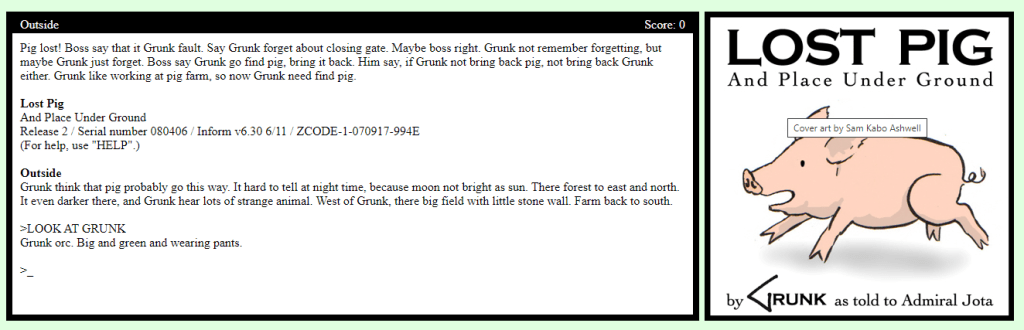
Popular history holds that text adventures died in the 1980s, but the secret history of interactive fiction is a saga of dedicated scholars toiling away at lovely gems that rarely see light outside the internet’s murky depths. For those willing to explore these highly-personal parser empires and hyperlink metropolises, so long as you can get over reading as gaming, you are in for something special. During the online IF renaissance Lost Pig emerged as a classic, especially well-suited for newcomers.
Lost Pig will have you grinning right off the bat with its ultra-low stakes: you are Grunk, a well-meaning simple-minded orc tasked with recovering a fugitive pig. A few minutes later you’re stuck in the underground micro-kingdom of an alchemist gnome, who thank god, is infinitely patient with Grunk being completely out of his depth.
The emphasis is definitely on puzzles, but the playful tone is what you’ll remember. The game responds to an impressive range of crazy inputs, provides generally fair environmental clues, includes an optional progressive hint system, and feels like it wants you to have a good time even when stumped. I’d score it higher but it’s over all too soon! I wish there’d been a few more chapters and couple more characters to meet.
Score: 5 / 10
–Brian
Lost Pig is written from Grunk’s point of view and fully captures the innocence with which he views the world. The premise is simple: Grunk accidentally left a gate open and a pig escaped from the farm. He must find the pig and return it.
From the beginning, I was worried that Grunk’s simplistic language and habit of referring to himself in the third person would be off-putting, but it was perfect for the light-hearted tone of the game. In one of my favorite lines, Grunk states “Grunk not remember forgetting, but maybe Grunk just forget” – something I connect with on so many levels. Seeing the world through Grunk’s eyes in Lost Pig was simply charming.
Though the story is far from grand, the puzzles have a level of refinement you wouldn’t necessarily expect. My biggest complaint is that the game is short and I would have loved to see what other antics Grunk and Pig could have gotten up to.
Score: 6 / 10
–Kelley
English Country Tune (2011)
Indie puzzlesmith Stephen Lavelle (of Increpare Games) holds the world record for making the most video games. In case you’re curious, 423 at the time I’m writing this review, many using PuzzleScript, a programming language designed expressly for creating Sokobon variants. His masterpiece is Stephen’s Sausage Roll, which I can safely call the best sausage-themed game in the known universe.
English Country Tune isn’t as perfect at Sausage Roll, but it’s a strong runner-up.
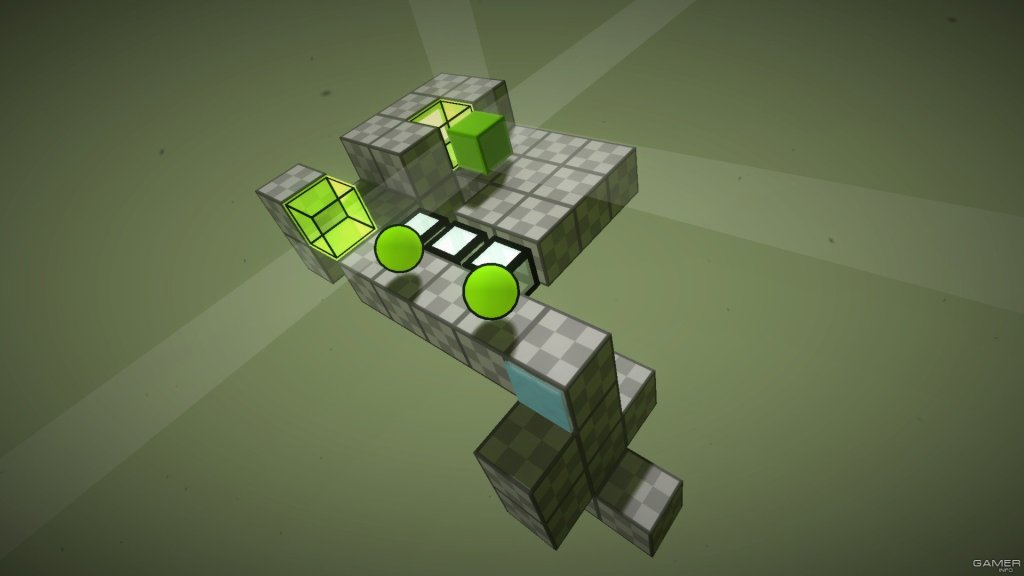
In ECT you control a square tile the can flip from surface-to-surface on structures composed of three dimensional blocks. In the early stages you just need to slap spheres into “incubators.” There’s a twist though: the spheres obey a personal gravity dictated by the ground you were on when you last slapped them. If this sounds complicated and a little hard to visualize, be warned: it’s just the first of several clever, but mentally-taxing mechanics to master.
Lavelle rarely provides instructions or hint systems, so expect a steep learning curve early on. You’ll need to break through the initial levels to see just how much depth there is within, but once you get there you’ll find English Country Tune to be a rewarding collection of expert-level spatial puzzles. Just keep in mind this is a purely mental exercise; don’t expect story, character, or fancy graphics.
Score: 7.5 / 10
–Brian
Stealth theme is… pork sausage links! Sidenote: I originally planned to make every trio have a theme, but dear god that was hard to juggle. Some of them were much worse than this, if you can believe it.
For more in this series see 2019 Trios.
 Significant Gamers