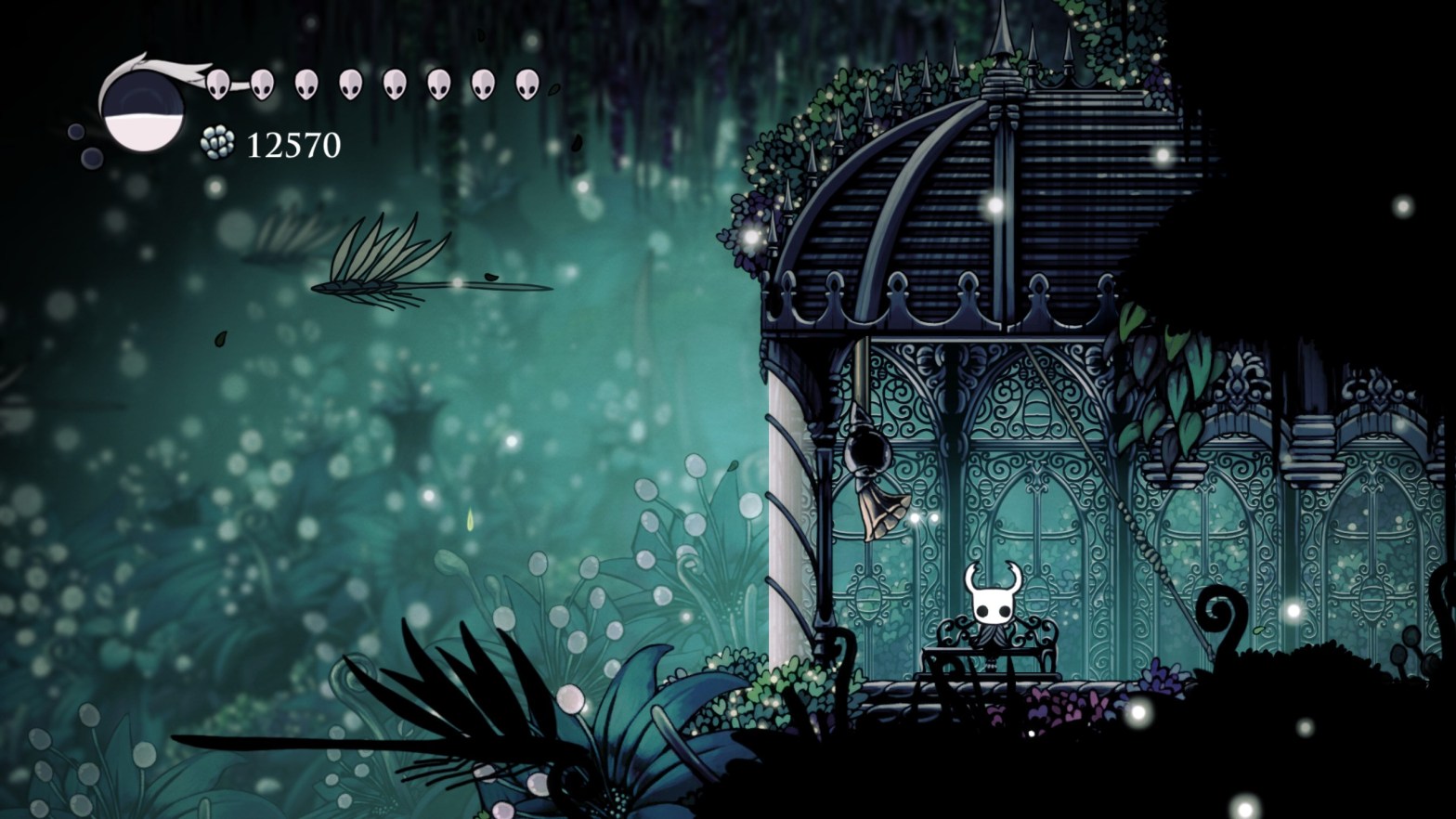
Hollow Knight for the PS4. Image credit: https://gamingbolt.com/
Hollow Knight (2017)
Side-scrolling metroidvanias are my jam, but Hollow Knight made me feel like I’d shown up to the digital equivalent of American Ninja Warrior naked except for a blindfold. It’s a brilliant game that was so hard I was rarely able to enjoy the craftsmanship. And that’s a shame because so much love has been lavished on this idiosyncratic and ever-so intricate insect kingdom.
The art style is like an adorable cartoon illustrated by a depressed Lovecraftian entomologist. The setting is the Hallownest, once a bug-based civilization of cities and gardens, merchants and soldiers, gods and monarchs. Now it’s a ghost town haunted by empty shells, mindless creatures, and forgotten lore.
The few eccentric loners that speckle this empire of underground ruin are precious to the player: brave, curious Quirrel; scholarly, musical Conifer; brash, selfless Cloth; and even Tiso, who never respected me. Hell, even arrogant pipsqueak Zoe the Mighty and the outlandish Dung Defender. I forgave them their creepy foibles and gradually considered them friends, though perhaps just because they were the only things not trying to kill me. Actually, Dung Defender definitely tried to kill me. Zoe, too. But at least they I didn’t have to run fetch quests for every sentient being I encountered; in fact, to these doomed denizens you are just the insignificant NPC encountered on their own respective quests.
The Hallownest is a joy to explore, as it seems like there are endless hand-drawn biomes to discover, full of sweaty-palmed platforming, nightmare critters, glittering crystals, pulsing fungi, thorny vines, poisonous lakes, and buried secrets. The Hallownest is also a royal pain to explore because save points are rare, maps must be earned, everything is lethal, healing can’t be taken for granted, bosses are brutal, plot points are exceedingly obscure, and dying involves a Dark Souls-inspired mechanic that scratched tiny permanent scars into my psyche: you lose all your money unless you can return and fight your ghost to reclaim it. I’m glad I plunged into the dark loamy borrows of Hollow Knight. But I’m also glad to be back above ground again.
Score: 8.5 / 10
–Brian
Elder Scrolls V: Skyrim (2011)
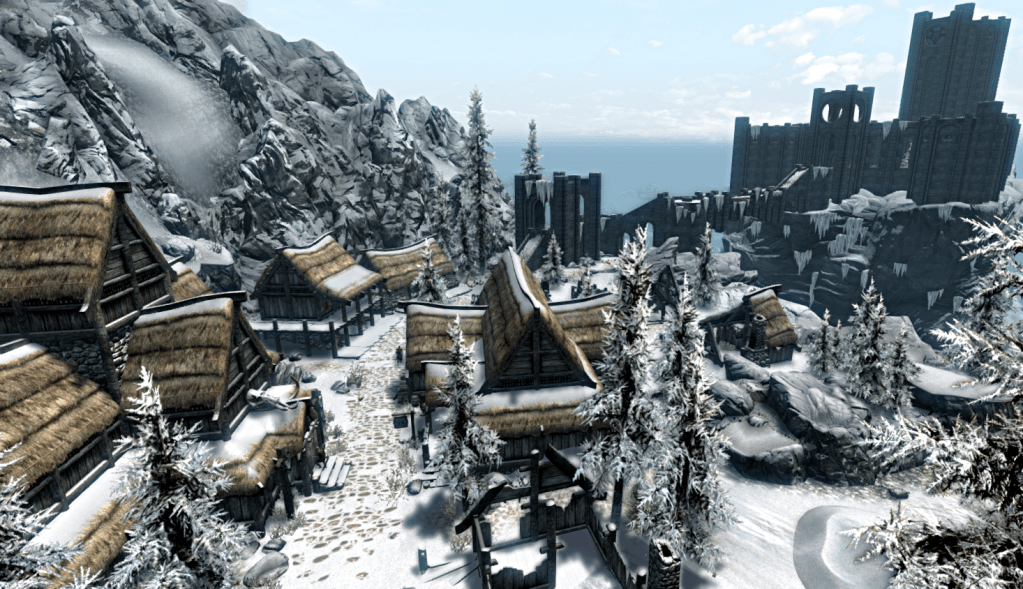
I’d never played an Elder Scrolls game before and I was intimidated going in, especially since Skyrim’s reputation was for quantity over quality. I tend to prefer trim, crafted experiences, but it didn’t take long for me to fall in love with Bethesda’s maximalist approach. A huge world beckons to be explored. A population of diverse NPCs make the cities and races and politics feel alive. There are so many sidequests you will literally lose track.
Many dungeons draw from a limited set of palettes that eventually feel samey and even redundant, but it took a long time before I minded because the skill progression system is so incredibly satisfying. You get no XP for killing monsters or completing quests, instead XP comes from using any of 18 skills (from conjuration and lockpicking to archery and smithing) just in the course of playing. Boost enough skills and your character levels up, allowing you to choose from a vast constellation of perks that lead to different play styles.
The 2011 graphics and the tendency for bugginess (again, polish is not the watchword here) are compensated for by the dedicated modding community, who have improved nearly every aspect of the game: bug fixes, water physics, weather phenomena, high-res textures, improved flora, detailed armor, and the all-important hairstyle packs. A mod Kelley and I were particularly interested in, Skyrim Together, allows you to play co-op, but given its shaky state at the time we started, we instead played separate games while chatting over headsets (more on that in Kelley’s review).
Skyrim does have one flaw that the mod community can’t fix: the main story is kind of blah, with an ending that is famously less climatic then some of the optional sidequests. This is a game that is at its best when you are just romping through the hillsides maybe vaguely planning to clear a distant fortress to tick off a dangling quest when you suddenly get attacked by a bear, or notice a tempting bandit camp, or stumble onto an entire forgotten dwarven city.
Score: 9.5 / 10
–Brian
Brian and I started playing Skyrim independently within a few days of each other. This led to one of my favorite gaming experiences of the year, Skyrim-by-phone. Though we were each playing the game ourselves, there was a sense of friendly competition to see who got the first house (him), who killed the first dragon (okay, also him), and who was the first to explore some far-off land (both of us). We commiserated about quests, shared locations of shops, and discussed how our very different styles of play were working for us. We are both extremely pro-exploration and side-quest, but he was a ranged character who relied heavily on bows and attack magic and I played a dark elf who was very in-your-face with her mace.
The regions of Skyrim felt fresh and different from one another and the story wove between them quite well. I often find dragons to be a crutch in fantasy, but even they worked as a major plot device! Until the ending. I have rarely been so let down by how a game chose to end. After tens of hours of build up on the main quest path, you fight the big bad and the game just is done? Brian happened to be over (having already beaten the game) when I finished the last section of the main plot and witnessed my great disappointment. There was no fanfare, no credits, no banner of congratulations, not even a pat-on-the-back from my longsuffering housecarl Lydia – just a portal back to Skyrim and the ability to do more of the seemingly-endless side-quests.
Skyrim tapped into my love of exploring and did so in a way that let me get truly lost in the game. Despite my issues with how the main plot ended, I will definitely play another Elder Scrolls title in the future.
Score: 10 / 10
–Kelley
Mirror’s Edge (2008)
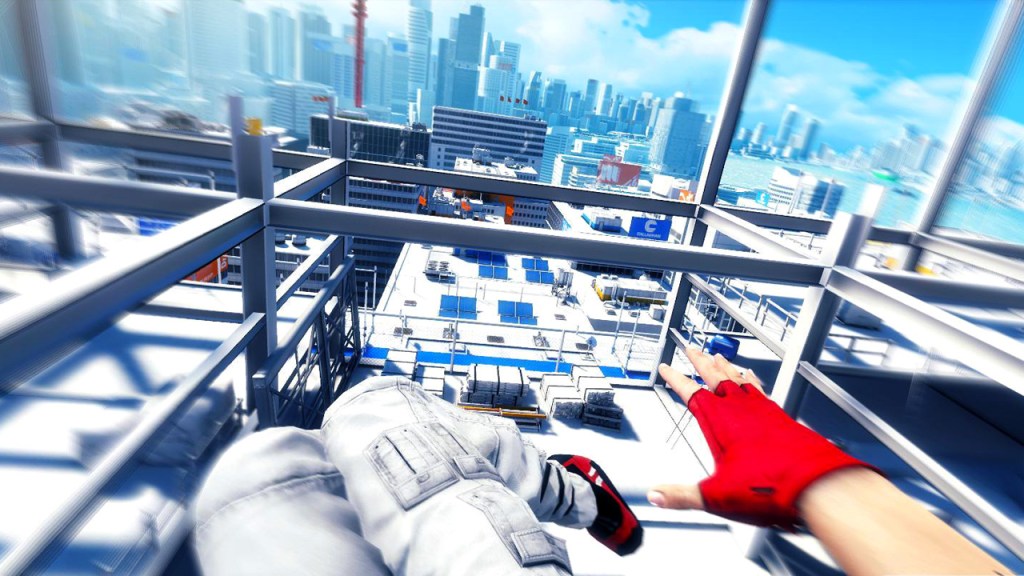
I wanted to like Mirror’s Edge so more than I actually did. It’s an original property with a unique approach: first-person parkour. Our verbs are run, jump, slide, and climb instead of the usual shoot, sneak, or talk. The premise is promising: an authoritarian utopia where people live in technological comfort under an iron heel, and those dedicated to resistance opt to communicate via athletically analog couriers instead of telecommunications. The graphics are simplistic but striking: sterile white steel and glass with highlights in a single saturated hue. Objects that can help you traverse appear red as you approach. And the protagonist, the unfortunately named Faith Connors (hey, at least is isn’t Eve Shepherd), is an Asian woman, which shouldn’t be conspicuous, but was refreshing in the gaming ecosystem of 2008 (and, sigh, still today).
However none of this quite delivers in the finished product. The gameplay is often stiff and the routes confusing. Faith can long jump like a beast and has more upper body strength than an Olympic gymnastics team, but she’ll blissfully waltz off a rooftop and die without batting an eye. Rounding corners is her kryptonite. Modern games like Assassin’s Creed and Spiderman have spoiled me by interpreting my laziest key press as a sequence of triple axels, but Faith won’t pull herself up from a ledge grab while pursued by a chopper unless I explicitly tell her it’s time to get a move on. There were a couple chase scenes where Mirror’s Edge lays off the path obfuscation and I finally achieved the balletic flow you’d expect, but for most sequences you’ll replay again and again until you figure out where you’re supposed to shimmy and wall jump.
The graphics get old quick, as there’s very little environmental variety and we spend far too much time in those ubiquitous ventilation ducts that are only human-sized in video games and Die Hard movies.
The plot is told via graphic novel-esque cut scenes that I found pleasingly bright and angular, but it’s just cliché casserole. And, for reasons that escape me, these aren’t even sci-fi clichés! Instead we get served the warmed-over leftovers from some paint-by-numbers cop movie. The glittering metropolis masks a conspiracy just beneath the surface. Your sister is framed for murder. Corrupt politicians and assassins scurry about. Shady business down at the docks! Will someone close to you betray you? Yawn. Even Faith is a bit of a letdown. Her kick-ass look: face tattoo, edgy hair, and functional sportswear is as deep as her personality goes. But at least we don’t have to put up with a love interest.
Score: 5.5 / 10
–Brian
For more in this series see 2019 Trios.
 Significant Gamers