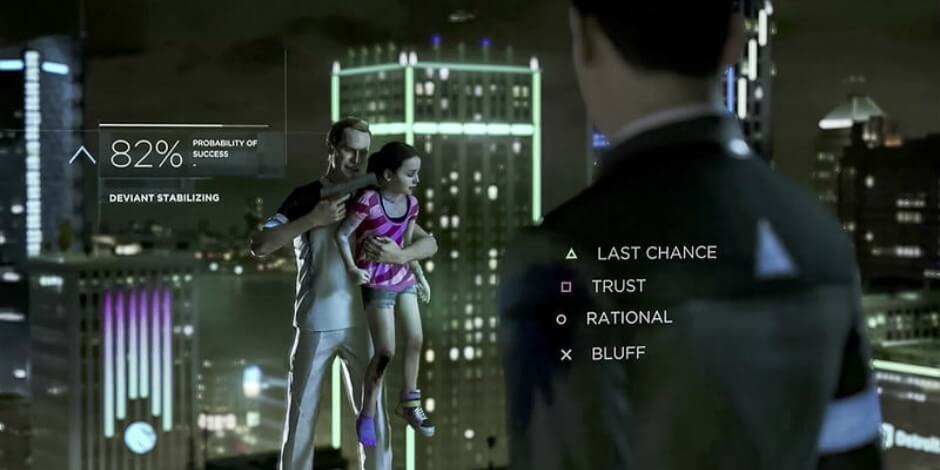
Detroit Become Human for PS4; Image Credit: techantidote.com
Detroit Become Human (2018)
Detroit Become Human follows the paths of three androids: Connor, a hostage negotiator and police investigator; Kara, a housekeeper; and Markus, a caretaker. As the name suggests, the game is set in Detroit, where tensions are high, androids are property, and some are starting to “deviate” from their original programming. The three characters all tackle this in a different way. Connor helps the police track down deviants. In the opening scene of the game, Connor is called in to try and save a little girl from her turned android caretaker. (Thus providing the first of many ways for Connor to die.) Kara goes deviant to protect a child from the man who purchased her. Markus is framed for a crime he didn’t commit and goes in search of the fabled Jericho, where deviant androids live together in peace.
The chapters switch between the characters, with decisions made earlier in the game influencing the choices you have later. When Kara was cleaning the house, did she find the gun? If yes, in a pivotal scene, will she use it to protect the child she cares for? Many of these choices must be made with the added stress of a countdown timer and the knowledge that killing an NPC may mean limiting your options for the rest of the game. At the end of each chapter, you see a flowchart of all of the choices that were available and the percentages of players who made the same decisions you did. As a data nerd, this was fascinating! You also have the opportunity to go back and replay the chapter to unlock decision points you missed. This is a convenient way to un-kill NPCs and Connor. (Oh, Connor.)
The cinematic nature of the game, the strong writing, the weaving together of narratives, and the big reveals all worked for me. Were there times I sighed at the predictable path some characters take or the heavy-handed messaging, yes, but I enjoyed every moment.
Score: 9 / 10
–Kelley
Detroit Become Human gets a lot of things right. The pacing has you changing characters and settings frequently, with segments centered on character building, world building, action, philosophizing, investigation, and horror. The player makes meaningful choices and feels in control. Character motivations and the links between decision and consequence ring true. The character models and motion capture performances are strong enough for us to finally crawl out of the uncanny valley, and even develop emotional bonds and digital crushes.
French developer David Cage and his company Quantic Dream have been chasing the grail of interactive movies since Omikron: The Nomad Soul in 1999. 2010’s Heavy Rain demonstrated how much potential was in the Cage formula: criminal investigations with branching stories tied to quick-time events. It was also one of the first games I played surrounded by friends with everyone getting invested and shouting advice. Kelley and I did a series of group events for Detroit Become Human and I absolutely recommend it if you are into social gaming.
Little things I liked: scrappy Detroit getting some love, uncomfortable surveys between gaming sessions, good UI on the branching flowchart.
Score: 8 / 10
–Brian
SteamWorld Dig 2 (2017)
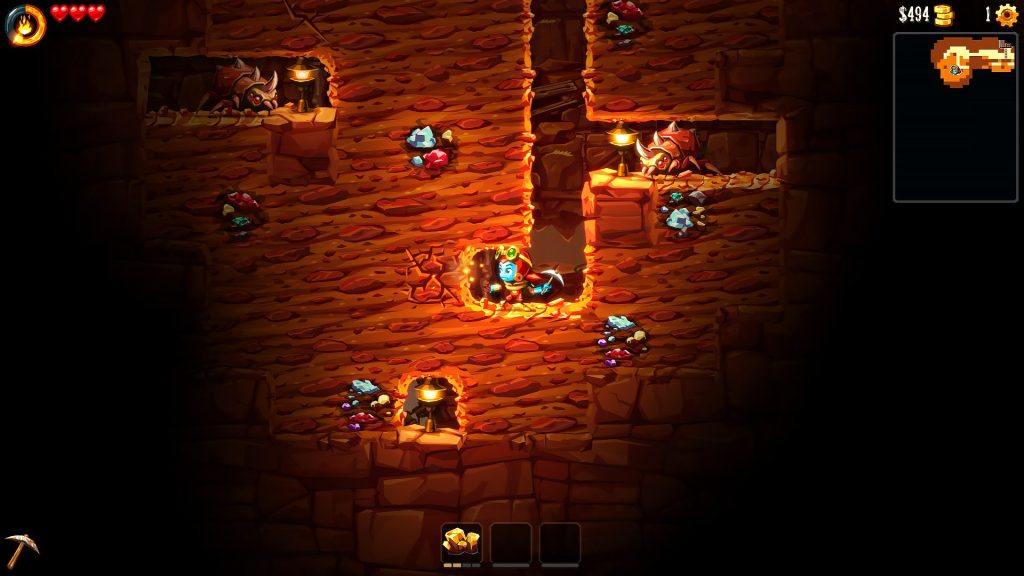
In SteamWorld Dig 2, you play Dorothy – a robot trying to find her missing friend (and protagonist of the first SteamWorld Dig game) Rusty. She has heard rumors that Rusty was spotted in the town of El Machino and goes to investigate. When she arrives, El Machino is being ravaged by a series of earthquakes. Dorothy wants to go into the mine under the town to look for Rusty, but the mayor only agrees if she searches for the source of the earthquakes at the same time.
Simply put, SteamWorld Dig 2 is a mining exploration platformer. Dorothy starts with basic equipment and mines ores to sell at the shop in El Machino. From there, she can upgrade (level limiting) to get stronger tools and abilities, which allow different types of ore and rock to be mined. Dorothy does need to return to the surface after a time to allow her solar lantern to charge. Though this can be frustrating, it makes the player think about digging in such a way that Dorothy can get out – leaving platforms of a height she can jump, remembering the path back to the nearest pneumatic tube (fast-travel), and not accidentally mining in places that are detrimental to the infrastructure she already created.
One of the things I liked most about SteamWorld Dig 2 is that there are two ways that you can play – with or without guidance directing you towards the next goal. I chose to play without guidance and found it a very enjoyable experience that foregrounds exploration. I firmly believe this play-choice let me find more hidden areas, puzzles, and collectibles. Though the story seemed secondary to the delight of mining, I thought SteamWorld Dig 2 was an extremely pleasant and low-stress game. I found the steampunk-meets-desert style appealing and loved the exploration of the mine.
Score: 7 / 10
–Kelley
Another World (1991)
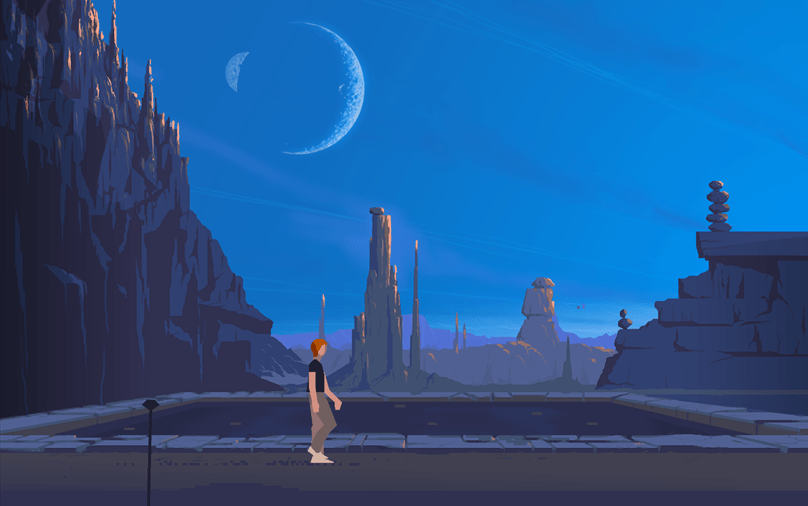
One of the earliest definitions for what a video game could be was “interactive movie.” This led to a design style of cinematic games whose influence is still felt today (see The Last of Us or any Metal Gear Solid title). There’s a strong case that the origin of this approach is Another World, a 1991 adventure platformer released for the Amiga. You play a physicist accidentally teleported to an alien world where you must survive and escape. The non-verbal storytelling, early example of an NPC sidekick, vivid vector-based backdrops, smooth rotoscoped animation, and brief but effective cutscenes were groundbreaking in their day.
Unfortunately, that day was almost three decades ago, and Another World is virtually unplayable now. On one hand, the puzzles in Another World or well integrated with the adventure compared to the random gates locked with spatial-logic riddles found elsewhere in the genre. But on the other hand, “solving” the puzzles typically involves repetitive trial and error sessions where the slightest misstep means death. Things get even worse in the game’s action-heavy second half, where moving forward requires memorizing exact sequences of shooting and shielding. I must admit I gave up well before the finale. Another World gave us many innovations, but its weak spot is gameplay, consigning it to the status of historical footnote.
–Brian
Score: 2.5 / 10
For more in this series see 2019 Trios.
 Significant Gamers