Snipperclips (2017)
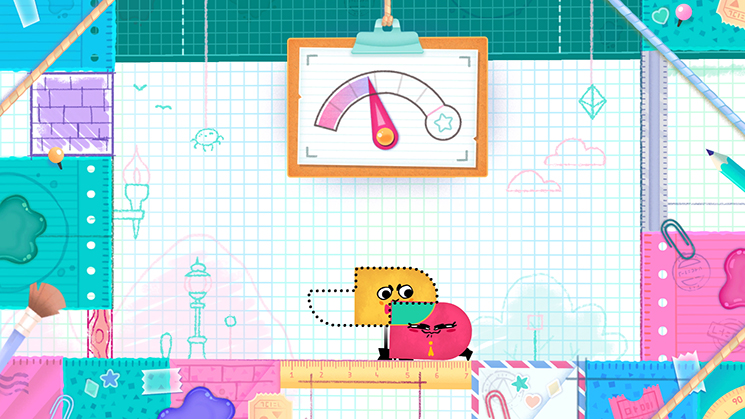
Snipperclips is so cute and kid-friendly that it risks getting dismissed before you’ve fully peeled back its many layers. You and a friend are little more than stick figures with googly-eyes, except that your rotatable bodies are mission-critical shapes: rounded on one end and sharp-corned at the other. You can overlap your body with the other player (or sometimes other objects) and “clip” the overlapping area away. Snipperclips exercises this mechanic in a variety of ways: usually requiring you to create and then pose in specific forms or accomplish a small goal by turning your body into a tool like a wedge, point, wall, or bowl to pry, pop, block, or carry.
Originally a bit too light-weight, extended content has made this into more than a single-sitting morsel without sacrificing the highly-manageable, single-screen, one-task-at-a-time simplicity that is part of the charm. Snipperclips is the perfect puzzle-game for a co-op “first date” before committing to a longer or harder experience.
Score: 7 / 10
–Brian
Snipperclips was a co-op game we played early in 2019. Brian had previously been introduced to the concept of rotating and snipping away at the bodies (and souls?) of two adorable half-pill-shaped characters, but it was a new and novel thing for me.
Anyone who has talked to me about video games knows that aesthetics and cuteness-factor can help elevate a game from blah to yay. Snipperclips benefited from that bump. The puzzles were relatively simple, but the need to work together to cut just that corner off required a surprising amount of communication and caused quite a lot of laughter when one of us accidentally snipped the other in half. The puzzles built in difficulty over the course of the game, but completing them was never a great task. In all, Snipperclips was a pleasant romp filled with hidden truths about what happens when scissors go rogue.
Score: 8 / 10
–Kelley
Spider-Man (2018)
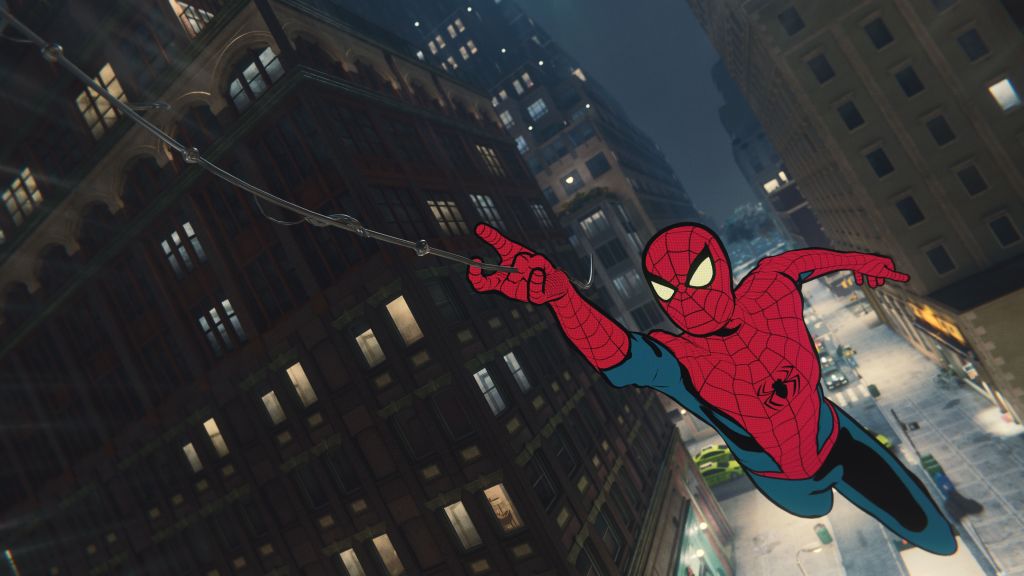
I have a theory that digital gaming is the medium where superheroes actually belong. The films are mostly terrible; a rant for another day. Yet while I have trouble getting excited about actor-costume composites battling waves of CG on the silver screen, if I get to control the superhero, I suddenly get the appeal. Consider, too, how many superhero cliches are just poor translations of triple-A game conventions: stories hinge on simplified power fantasies, heroes are never allowed to die, abilities and mechanics get the spotlight, conflicts are resolved by violence, and conclusions are always boss battles. Spider-Man was already one of the least tedious franchises, eschewing grimdark pomposity for character, charm, and one-liners – all of which have been preserved in the game.
As every reviewer will tell you, they’ve nailed the spider-slinging-and-swinging mechanic. It’s immediately bracing and empowering. Getting between hotspots in open-world Manhattan is a pleasure in its own right, which is great because you’ll be swinging into action not just to advance the much-better-than-it-had-to-be plot, but to stamp out the semi-random real time crimes springing up every few blocks (Manhattan, amirite?).
Combat follows the Batman Arkham model of rhythmic button mashing. Every free-style riff is rendered into punches, kicks, and web shots. You’re crazy powerful (duh), but you get overwhelmed by numbers plus bazookas are involved, so thinning out grunts requires occasional dips into your arguably-excessive arsenal of gadgets and special suit abilities. This is an open world game so there are backpacks to collect, photos to take, optional side-quests, and sundry mini-games. You play Mary-Jane Watson and Miles Morales in stealth sequences. These are a bit tamped down compared to Spidey, but help invest you in the game’s character-driven approach. And of course there are epic boss battles. These really takeoff in showdowns against supervillain pairs, where the presence of two distinct, asynchronous move sets generates emergent gameplay and requires on-the-fly tactics.
Score: 9 / 10
–Brian
Brian and I have different opinions on the place superheroes should occupy in media, but we do agree that videogames are one of the best. Spider-Man lets the player step into the shoes of Peter Parker – photographer, lab tech, diligent nephew, gadget creator, and web-slinging superhero – and it does so with a good story. Does the game benefit from not needing to spend a lot of time on a rather universally-known backstory? Absolutely. It takes all of that for granted and starts with Peter getting an eviction notice for unpaid rent. Immediately your heart goes out for the guy who is following his low-paying dream career, stopping crime all over Manhattan, and, in his spare time, helping out at Aunt May’s nonprofit F.E.A.S.T (Food Emergency and Shelter Training). Throughout the game, you come to know the characters of Doctor Octavius, Harry Osborn, Mary-Jane Watson, Miles Morales, and Aunt May. You celebrate their successes and feel for them in moments of pain.
One of my favorite things about video games is the exploration. When Spider-Man gave me the chance to find hidden backpacks and take photos all over the city, I was in! I actually had to be reminded on several occasions that it might be a good idea to save some of the fun exploration stuff for when I needed a combat break in the game. (I largely ignored this advice.) Where I loved the exploration aspect, I hated the web-swinging. I never could quite get the hang of it, which made some forced web-swinging sections difficult.
I found combat enjoyable, though not particularly sophisticated. This is probably largely due to my playing style. While Brian played a gadget-heavy game where he was constantly switching between tech, I tend to not open up menus during combat/stealth sequences because I find it breaks my flow and concentration. This meant that I really just went in with one gadget equipped and hoped that my strategy of hiding to pick off the bad guys one-by-one would be enough. That usually worked. For me, the humor and character-driven story more than made up for any other issues I had with Spider-Man.
Score: 8 / 10
–Kelley
Mu Cartographer (2016)
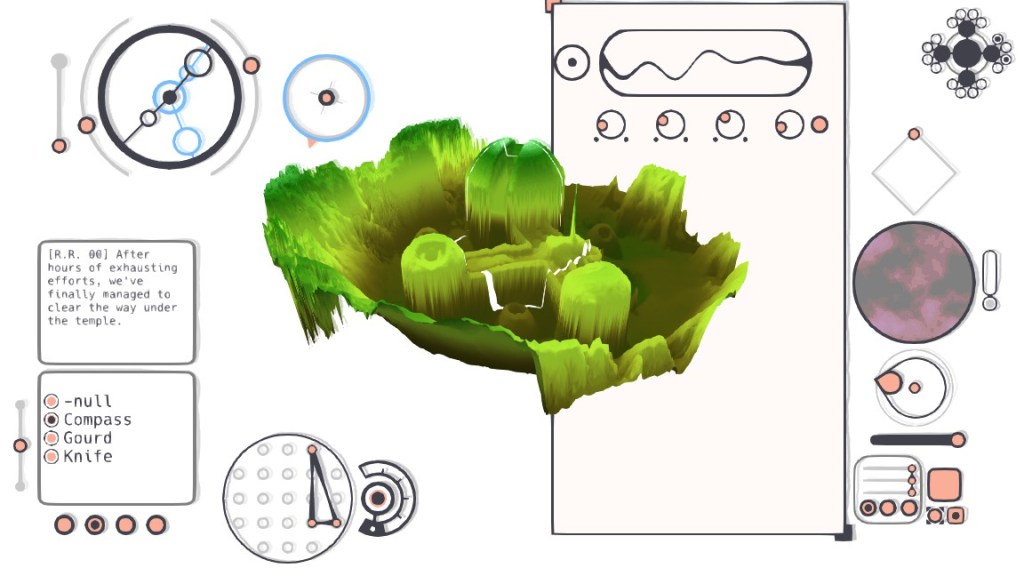
Give Mu Cartographer credit for creativity. I’m not even sure what genre it falls under and that’s generally a good sign. Essentially, it’s a colorful cross between a topographical map in a petri dish and a three dimensional audio wave visualization. Around the edges of the screen are a bunch of exotic buttons and dials. In case you weren’t aware that you were in a mid-2010s indie game, there is no tutorial and the expectation is that you will enjoy the process of learning what each gadget does, how they all interact, and the criteria for progress. Once you get your sea legs, most of the game involves tuning a sort of alien ham radio to search for anomalies quite literally lost in the otherworldly noise.
Mu Cartographer is actually rather relaxing. Waves of smooth synth and psychedelic shades wash over you as the tale of a vanished expedition takes shape. If you’re the type of person who likes fiddling with odd curios long after the indifferent masses lose patience, you might give this a try. It won’t break your bank, but it isn’t likely to blow your mind.
Score: 4.5 / 10
–Brian
For more in this series see 2019 Trios.
 Significant Gamers